Ballot Measure Index
In Washington State, as in many other states in the American West, the people have the direct power to make laws and reject laws adopted by the Legislature through what is often referred to as the initiative and referendum process.
The initiative and referendum are two of the instruments of direct democracy championed by progressive reformers in the 1900s. A group of reformers based here in the Pacific Northwest led an effort to change Washington’s Constitution to bring direct democracy to the Evergreen State around ten years into the twentieth century.
This effort, led by the Direct Legislation League, produced the Seventh Amendment to the Constitution of Washington State, approved by the Legislature in the 1911 regular session and ratified by voters the following year. Since the adoption of the Seventh Amendment, the beginning of Article II, Section 1 has read as follows:
SECTION 1 LEGISLATIVE POWERS, WHERE VESTED. The legislative authority of the state of Washington shall be vested in the legislature, consisting of a senate and house of representatives, which shall be called the legislature of the state of Washington, but the people reserve to themselves the power to propose bills, laws, and to enact or reject the same at the polls, independent of the legislature, and also reserve power, at their own option, to approve or reject at the polls any act, item, section, or part of any bill, act, or law passed by the legislature.
The above language makes clear that Washington is principally a representative democracy, but that the people do have the power to act as legislators if they so choose. The initiative was conceived not as a replacement for the Legislature, but as a complement to it, as the following excerpt from an advocacy pamphlet created by the Direct Legislation League makes clear:
Of course, it is not proposed that the people shall do much of the law making, for all have their private affairs to attend to and do not wish to be unduly bothered with these matters. We shall always need the services of trained legislators, and so long as they give us faithful, disinterested and reasonably wise service, we shall not interfere. But we seldom get such service, and we many times need the power of Direct Legislation so that we may lock the barn before the horse is stolen. Without these powers we are not truly self-governing, but merely elect other men to govern us who have, for the most part, been selected by party bosses and machines.
Under our present system the sole law-making power is vested in the legislature. The great store of integrity and political wisdom that rests in the mass of the people is lost because we allow a few legislators, often controlled by corporate and other selfish interests, to dictate the whole policy of the state. The legislature should advise and lead, but when that body misleads we must have the power to stop it. When this power is once vested in the people, the legislature acts in such a way as to almost obviate the necessity of its use.
Throughout Washington’s history, the initiative has served as a relief valve, allowing the people to bypass a gridlocked, unresponsive Legislature. It is thanks to the initiative that we have the Public Disclosure Commission, the presidential primary, the prohibition against smoking in workplaces, and near-universal background checks on gun sales.
Sadly, in recent years, the initiative has been regularly hijacked by the greedy and powerful, and maliciously used to inflict harm on Washington’s communities. What was originally conceived and initially used as a tool to make government work more effectively is now just as often a weapon used by the right wing to launch Trojan horses.
The progressive reformers who brought us the Seventh Amendment likely never imagined that there would come a time when initiatives would be a big business.
But that’s exactly what has happened. These days, getting on the ballot is guaranteed if you have a big checkbook and are willing to write a few six-figure checks to hire petitioners to collect a few hundred thousand signatures… or, if like Grover Norquist clone Tim Eyman, you have wealthy patrons with that kind of check-writing power.
A public vote can thus be forced on almost any conceivable scheme, whether it has merit or not, and whether it is constitutional or not.
The Seventh Amendment regrettably did not provide for a mechanism of prior review of initiatives, so there is no system in place to catch and weed out defective measures prior to an election, as there is in other states like Alaska. All that appears on the ballot is a short description of the measure, which can be one sided and lacking in context. Voters who do not consult the voter’s pamphlet or do their own research may be unaware of the implications of what they are voting on before casting a ballot.
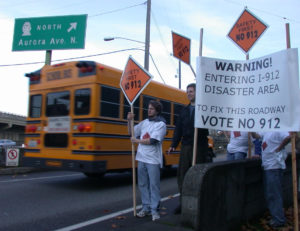
Since the late 1990s, Tim Eyman and other right wing actors have exploited these shortcomings. They’ve repeatedly introduced and qualified for the ballot a slew of initiatives purposely intended to defund vital public services, undermine Washingtonians’ confidence in their elected representatives, and wreck our government so it ceases to function as our state’s Founders intended.
These bad ballot measures are cataloged below. For each initiative, we’ve created a dedicated profile that details the threat it posed to Washington.